


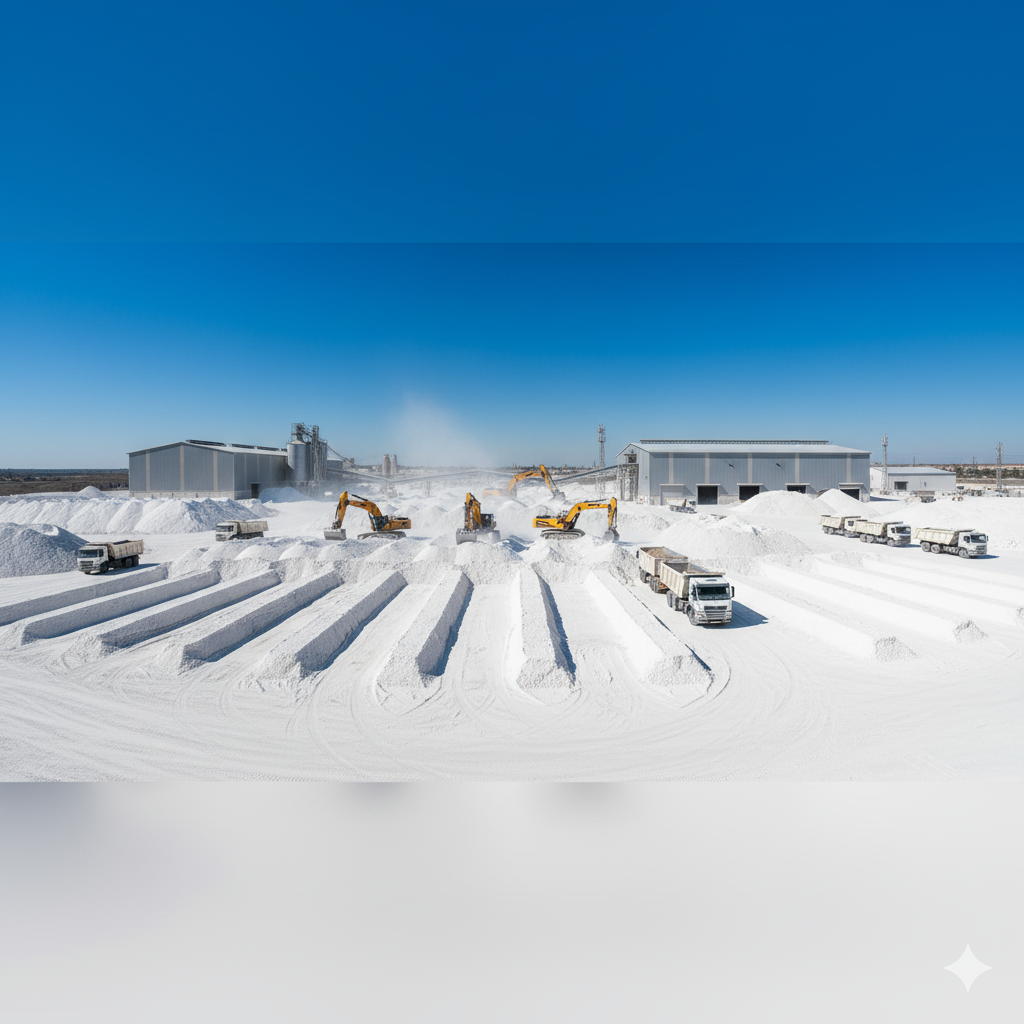
In the industrial minerals world, choosing the right clay plays a critical role in product performance, manufacturing efficiency, and overall cost control. At Green Trade India, a leading manufacturer and exporter of premium kaolin clay from Gujarat, we often receive queries about bentonite vs kaolin and which clay is more suitable for specific industrial applications.
Although both bentonite and kaolin are natural clay minerals, they differ significantly in composition, physical behavior, and industrial performance. This detailed bentonite and kaolin comparison will help you understand their key differences, properties, and best use cases so you can select the right clay for your application.
Expert Summary: Bentonite vs Kaolin Clay
- Bentonite is best for applications requiring high absorbency, swelling, and binding
- Kaolin is ideal for ceramics, paper, paints, rubber, plastics, and cosmetics due to its purity and chemical stability
- Selecting the right clay improves product quality, process efficiency, and long-term performance
Understanding Bentonite and Kaolin Clay
When discussing bentonite vs kaolin clay, it is important to understand their mineral origins and natural behavior.
Bentonite clay is primarily composed of montmorillonite, a mineral known for its exceptional ability to absorb water and expand. This swelling property gives bentonite high plasticity, viscosity, and binding strength, making it valuable in drilling, foundry, and sealing applications.
Kaolin clay, on the other hand, is mainly composed of kaolinite. It is naturally white, fine-grained, chemically inert, and does not swell when exposed to water. These properties make kaolin highly suitable for precision manufacturing processes that demand purity, smoothness, and dimensional stability.
Key Differences Between Bentonite and Kaolin Clay
The difference between bentonite and kaolin lies mainly in their physical behavior, absorbency, and chemical stability.
Bentonite exhibits high plasticity and water absorption and expands several times its original volume when hydrated. Kaolin remains stable in shape, absorbs very little water, and maintains consistent particle structure.
In kaolin clay vs bentonite clay, the contrast between absorbency versus stability becomes the most important deciding factor.
Bentonite vs Kaolin: At-a-Glance Comparison
| Feature | Bentonite Clay | Kaolin Clay |
|---|---|---|
| Main Mineral | Montmorillonite | Kaolinite |
| Swelling Property | High swelling | No swelling |
| Water Absorption | Very high | Low |
| Color | Grey / Brown | White |
| Plasticity | High | Low to moderate |
| Chemical Stability | Moderate | Very high |
| Surface Finish | Rough | Smooth |
| Key Industries | Drilling, Foundry, Sealing | Ceramics, Paper, Paints, Rubber |
| Best For | Absorbency & binding | Purity & dimensional stability |
Kaolin Clay Properties and Performance
At Green Trade India, our kaolin clay is processed under strict quality control and certified by SGS to meet international industrial standards.
Key kaolin clay properties include:
- Low moisture absorption
- Bright natural whiteness
- Fine and smooth particle texture
- High chemical inertness
- Excellent dimensional stability
Because kaolin does not swell and remains chemically stable, it performs exceptionally well in applications requiring uniformity and surface quality. Compared to bentonite, kaolin delivers superior results in ceramics, paper coating, paints, rubber, plastics, adhesives, and cosmetic formulations.
Industrial Applications of Bentonite vs Kaolin Clay
When selecting between bentonite vs kaolin for industrial applications, the choice depends on the functional requirement of the process.
Bentonite's swelling and binding properties make it indispensable in:
- Oil and gas drilling fluids
- Foundry sand molds
- Iron ore pelletization
- Sealing ponds and landfills
Kaolin's controlled particle size, purity, and smoothness make it ideal for:
- Ceramic bodies and glazes
- Paper coating and filling
- Architectural and industrial paints
- Rubber and plastic compounding
- Cosmetics and pharmaceuticals
Bentonite vs Kaolin by Industry
1. Oil & Gas Industry
Preferred clay: Bentonite
Reason: High swelling capacity and viscosity control for drilling fluids
2. Ceramics Industry
Preferred clay: Kaolin
Reason: Purity, whiteness, firing stability
3. Paper Manufacturing
Preferred clay: Kaolin
Reason: Brightness, opacity, and smooth surface finish
4. Foundry & Metal Casting
Preferred clay: Bentonite
Reason: Strong binding for sand molds
5. Paints & Coatings
Preferred clay: Kaolin
Reason: Particle size control and uniform dispersion
6. Rubber & Plastics
Preferred clay: Kaolin
Reason: Reinforcement and improved surface quality
Best Use Cases: When to Choose Bentonite or Kaolin Clay
A proper bentonite and kaolin comparison makes selection easier:
Choose bentonite clay when you need:
- High water absorbency
- Swelling and sealing properties
- Strong binding and viscosity
Choose kaolin clay when you need:
- Chemical purity
- Smooth texture and brightness
- Dimensional stability
- Consistent particle size
At Green Trade India, we supply kaolin in powder, granules, noodles, and crude forms, suitable for diverse industrial requirements.
Choosing the Right Clay with Green Trade India
Understanding the difference between bentonite and kaolin helps industries reduce process losses, improve product consistency, and maintain international quality standards.
Green Trade India, a trusted kaolin manufacturer and exporter from Gujarat, offers:
- Premium-grade industrial kaolin
- SGS-certified quality assurance
- Scalable production capacity
- Custom packaging solutions
- Reliable global export logistics
We help manufacturers select the right kaolin grade for optimal performance across industries.
Quick Answers: Bentonite vs Kaolin
- Most absorbent clay: Bentonite
- Best clay for ceramics: Kaolin
- Best for drilling fluids: Bentonite
- Best for paper coating: Kaolin
- More chemically stable clay: Kaolin
Conclusion
The choice between kaolin clay vs bentonite clay is not about which is superior, but about selecting the right material for the right application. Bentonite excels in absorbent and sealing applications, while kaolin delivers unmatched purity, stability, and performance in precision manufacturing.
If you are looking for high-quality industrial kaolin, Green Trade India is your reliable partner. Contact Green Trade India today to get premium kaolin clay tailored to your industry needs and global quality standards.
Our Popular Products
Raw Kaolin | Kaolin Powder | Kaolin Noodles
Frequently Asked Questions (FAQs)
1. What is the main difference between bentonite and kaolin clay?
The main difference between bentonite and kaolin clay is absorbency. Bentonite swells and absorbs large amounts of water, while kaolin remains stable and does not swell.
2. Which is better: bentonite or kaolin for industrial applications?
It depends on the application. Kaolin is better for ceramics, paper, paints, and rubber, while bentonite is preferred for drilling, sealing, and foundry applications.
3. Is bentonite more absorbent than kaolin clay?
Yes, bentonite has significantly higher water absorption and swelling capacity compared to kaolin.
4. What are the common uses of kaolin clay?
Common uses of kaolin clay include ceramics, paper coating, paints, rubber, plastics, cosmetics, and pharmaceutical products.
5. Which clay is best for drilling and oil & gas applications?
Bentonite is the preferred clay for drilling and oil & gas applications due to its swelling, binding, and viscosity-controlling properties.
6. What is bentonite clay used for in manufacturing?
Bentonite is used in drilling fluids, foundry molds, pelletizing iron ore, sealing applications, and as an industrial binder.
7. Is kaolin clay better than bentonite for ceramics?
Yes, kaolin is better for ceramics because of its high purity, smooth texture, and firing stability.
8. Can bentonite and kaolin be used together?
Yes, in some formulations bentonite and kaolin are blended to balance binding strength with surface smoothness and stability.