


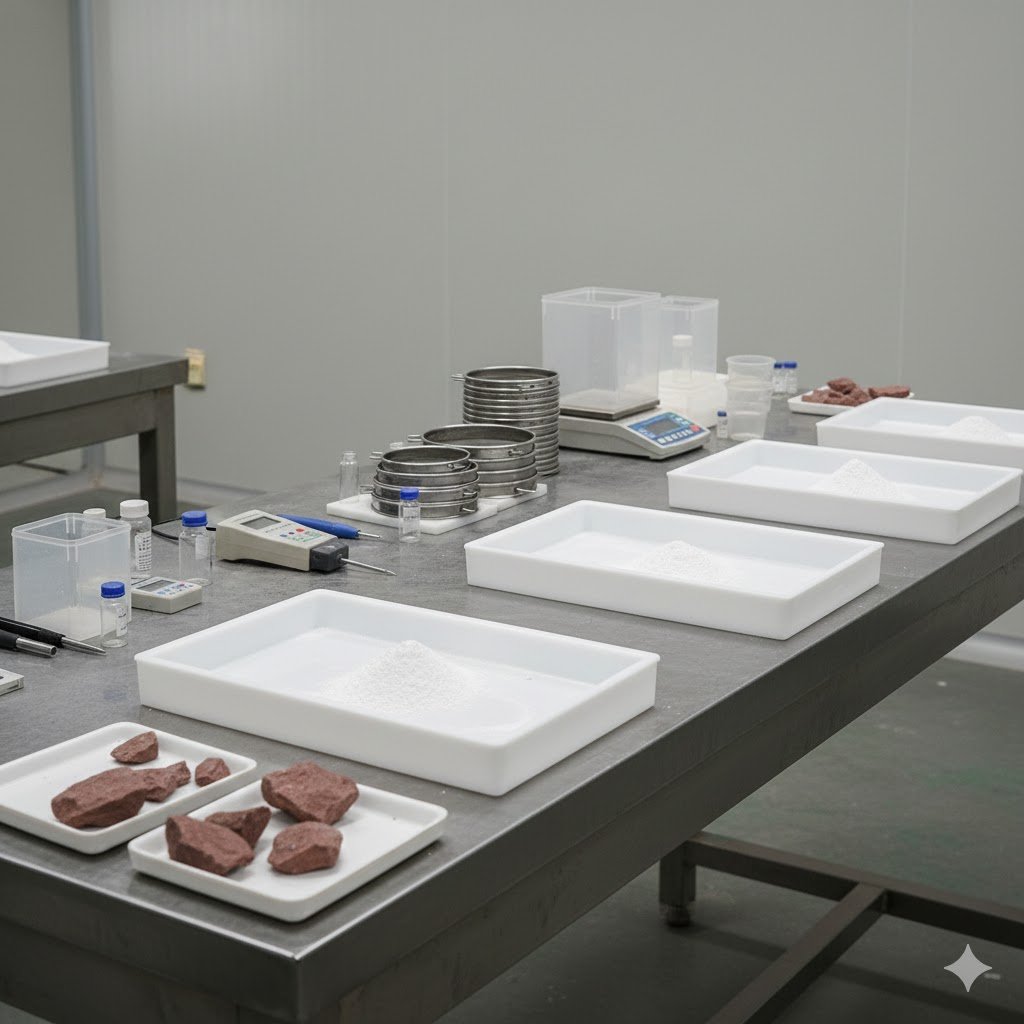
Choosing the right industrial kaolin supplier involves more than comparing prices per tonne. For manufacturers purchasing kaolin in bulk, product specifications, quality consistency, technical documentation, packaging, delivery schedules, and long-term supply capabilities all influence the value of a purchase.
How do you choose the right industrial kaolin supplier?
Start by defining your application requirements, comparing technical specifications on a like-for-like basis, reviewing quality documentation, and evaluating the supplier’s ability to fulfil repeat orders. The right kaolin grade depends on the intended manufacturing process, whether the material is used in ceramics, paper, paints and coatings, rubber, plastics or other industrial applications.
Green Trade India manufactures and supplies industrial kaolin products from Gujarat, India, including kaolin powder, kaolin noodles, kaolin granules and crude kaolin. This buyer’s guide explains how to evaluate kaolin manufacturers, understand essential specifications, compare supplier quotations and make informed decisions when purchasing bulk kaolin.
How to Choose the Right Industrial Kaolin Supplier for Bulk Orders
When purchasing kaolin for regular manufacturing operations, buyers need a supplier that can meet their technical requirements and support their procurement needs. Variations in raw material properties, processing methods and product specifications can influence manufacturing efficiency and final product quality.
Before selecting a supplier, evaluate the following factors:
- Product suitability: Confirm that the kaolin grade and physical form are appropriate for your intended application.
- Technical specifications: Review chemical composition, particle size, moisture, whiteness and other relevant parameters.
- Quality control: Understand how product properties are tested and monitored.
- Documentation: Request a Technical Data Sheet (TDS) and ask whether a batch-specific Certificate of Analysis (COA) is available.
- Bulk supply capacity: Confirm minimum order quantities, production availability and repeat-order arrangements.
- Packaging and delivery: Evaluate packaging options, lead times, transportation and delivery terms.
- Commercial value: Compare the complete delivered cost rather than focusing only on the quoted price.
For manufacturers, a suitable supplier should understand the intended application and clearly communicate the product specifications, commercial terms and supply arrangements. Establishing these requirements before placing an order helps buyers reduce procurement uncertainty and make more informed purchasing decisions.
Why Supplier Selection Matters for Industrial Kaolin?
Kaolin is a naturally occurring clay mineral used in various industrial applications. Its properties can influence processing behaviour, product appearance, and performance, depending on the formulation and manufacturing process.
Different industries have different requirements. Ceramic manufacturers may prioritize properties associated with forming, firing and finished-product quality, while paint and coating manufacturers may focus on whiteness, particle size and dispersion characteristics. Paper, rubber and plastic applications may require different combinations of physical and chemical properties.
This means that a kaolin grade suitable for one application may not be appropriate for another.
When selecting an industrial kaolin supplier, buyers should establish their required specifications and confirm that the offered material meets those requirements. Consistent conformity to agreed specifications is particularly important for manufacturers that purchase kaolin regularly and need predictable production outcomes.
What to Look for in Industrial Kaolin Manufacturers?
Working directly with kaolin manufacturers can help buyers understand product grades, processing requirements, quality-control procedures and available supply options.
When evaluating industrial kaolin manufacturers, consider the following questions:
- Can the manufacturer explain the characteristics of the offered kaolin grade?
- Is the product's origin and physical form clearly identified?
- Are relevant technical specifications and test documentation available?
- Can the manufacturer explain its quality-control procedures?
- Are packaging and bulk-order requirements discussed before the quotation is finalized?
- Can the manufacturer accommodate the buyer's expected order volumes and replenishment needs?
Green Trade India operates from Gujarat and manufactures and supplies different forms of kaolin, including kaolin powder, kaolin noodles, kaolin granules and crude kaolin. Buyers can discuss their intended applications, specifications, quantities, and packaging requirements to determine which available product is appropriate for their needs.
Evaluating these factors helps industrial buyers distinguish between suppliers based on their technical and commercial suitability rather than relying exclusively on price.
How to Compare Industrial Kaolin Suppliers
Comparing kaolin suppliers requires a consistent evaluation process. Two suppliers may quote different prices because their products differ in grade, processing requirements, technical specifications, packaging or delivery terms.
For a fair comparison, request quotations using the same product requirements and evaluate each supplier against the same criteria.
| Evaluation criteria | What buyers should check | Why it matters |
|---|---|---|
| Product grade | Grade and intended application | Helps establish material suitability |
| Chemical composition | Reported composition and specified limits | Supports application-specific requirements |
| Particle size | Particle-size distribution or fineness | Can influence processing and product performance |
| Whiteness | Reported value and measurement method | Important for applications with colour or brightness requirements |
| Moisture content | Specified limits and available test results | Can affect handling and material calculations |
| Quality documentation | TDS, COA where available and relevant test reports | Supports technical evaluation and batch verification |
| Batch consistency | Quality-control procedures and batch records | Helps maintain consistent manufacturing inputs |
| Packaging | Bags, jumbo bags or other available formats | Influences handling, storage and transport |
| Minimum order quantity | Minimum purchase and bulk-order requirements | Helps align procurement with consumption |
| Delivery terms | Lead time, freight and delivery location | Supports production and inventory planning |
| Commercial terms | Price basis, applicable taxes and payment terms | Enables accurate quotation comparison |
| Repeat supply | Availability and replenishment arrangements | Supports ongoing production requirements |
Supplier Comparison Checklist
Before finalizing a supplier, confirm that the quotations cover the same grade, quantity, specifications, packaging, and delivery destination.
A lower quotation may reflect a different product grade or exclude costs included in another supplier's offer. Buyers should also establish how quality deviations will be handled and which documents will accompany the material.
The most suitable supplier is one that meets the agreed technical requirements, provides appropriate documentation, and offers commercial and supply terms that align with the buyer's needs.
Industrial Kaolin Specifications Buyers Should Check
Industrial kaolin specifications describe the physical and chemical properties of a particular product grade. These properties help buyers determine whether the material is suitable for their manufacturing process.
The required specifications vary according to the intended application, so buyers should establish acceptable limits before requesting quotations.
| Specification | What it indicates | What buyers should confirm |
|---|---|---|
| Chemical composition | Chemical constituents of the material | Required composition and permissible variation |
| Particle size | Distribution of particle sizes | Specified size range, fineness and test method |
| Whiteness or brightness | Optical characteristics of the material | Required value and measurement method |
| Moisture content | Amount of moisture in the material | Maximum acceptable moisture level |
| pH | Acidity or alkalinity under defined test conditions | Required range and testing method |
| Loss on ignition (LOI) | Mass lost during heating under specified conditions | Applicable limit and test procedure |
| Purity and impurities | Relevant constituents and unwanted substances | Application-specific impurity requirements |
| Physical form | Form in which the product is supplied | Suitability of powder, noodles, granules or crude material |
Not every parameter is equally important for every application. Buyers should identify the properties that directly affect their manufacturing process and verify them against the supplier's technical documentation.
Procurement tip: Compare specification values only when the units, test methods and measurement conditions are sufficiently consistent. A numerical value alone may not provide a reliable basis for comparison.
How to Evaluate Kaolin Quality Testing
Quality testing helps buyers determine whether industrial kaolin meets agreed specifications. It is particularly important when the material is used as a regular raw material in manufacturing.
Depending on the product grade and application, testing may cover chemical composition, particle-size distribution, moisture, whiteness, pH, loss on ignition and other relevant parameters.
When assessing a supplier's quality-control process, buyers should consider:
- Which product properties are tested.
- Which test methods are used.
- Whether the reported results can be compared with agreed specification limits.
- Whether batch identification and test records are available.
- Whether quality documentation can be provided with repeat orders.
- How the supplier handles material that does not conform to the agreed specifications.
Green Trade India considers product specifications and quality information important elements of industrial procurement. Buyers should discuss the specific parameters they need to verify and confirm the available testing documentation before placing a bulk order.
Quality testing should be relevant to the application rather than treated as a generic checklist. The objective is to establish that the supplied material meets the requirements agreed between the buyer and supplier.
What Is a Kaolin TDS and Why Is It Important?
A kaolin Technical Data Sheet (TDS) provides technical information about a particular product grade. It may include chemical composition, particle size, moisture, whiteness, pH and other relevant physical or chemical properties.
Reviewing a TDS helps buyers assess whether a product is appropriate for their manufacturing requirements before committing to a bulk order.
TDS vs COA: What Should Kaolin Buyers Review?
A TDS and a Certificate of Analysis (COA) serve different purposes.
| Document | Primary purpose | What buyers should review |
|---|---|---|
| Technical Data Sheet (TDS) | Describes the technical characteristics of a product grade | Specified or typical properties, applicable test methods and suitability |
| Certificate of Analysis (COA) | Reports analytical results for a particular batch or lot, when provided | Batch identification, tested parameters, reported results and specification limits |
A TDS helps buyers shortlist a suitable grade, while a COA can help verify reported properties for a specific batch.
Before placing an order, buyers should confirm which documents the supplier provides and whether the reported parameters cover the properties that are critical to their application.
How Industrial Kaolin Pricing Is Determined
Industrial kaolin pricing depends on several technical and commercial factors. The product grade, processing requirements, specifications, order quantity, packaging, transportation and delivery location can all influence the final quotation.
The following factors should be considered when comparing prices from industrial kaolin manufacturers and bulk suppliers.
- Product grade: Different grades may have different properties and processing requirements.
- Processing level: Additional processing or tighter specifications may influence production costs.
- Order quantity: Prices can vary according to volume and commercial terms.
- Packaging: Standard bags, jumbo bags and customized packaging may involve different costs.
- Transportation: Freight charges depend on the quantity, destination and delivery arrangements.
- Quality documentation: Confirm the documentation and testing included in the quotation.
- Delivery terms: Review lead times, applicable taxes, unloading responsibilities and other charges.
How to Compare Two Bulk Kaolin Quotations
Use the same purchasing requirements when requesting quotations from multiple suppliers.
| Cost component | Supplier A | Supplier B |
|---|---|---|
| Product grade and specifications | Confirm | Confirm |
| Order quantity | Confirm | Confirm |
| Price per tonne | Enter quoted price | Enter quoted price |
| Packaging charges | Confirm | Confirm |
| Freight and delivery | Confirm | Confirm |
| Taxes and other applicable charges | Confirm | Confirm |
| Total delivered cost | Calculate | Calculate |
| Documentation and quality requirements | Confirm | Confirm |
The total delivered cost should be calculated using actual quotations and applicable charges. Buyers should also consider whether the offered material meets their specifications and whether the delivery arrangements suit their operations.
Green Trade India invites industrial buyers to discuss their required kaolin form, intended application, specifications, order quantity and delivery location to obtain a quotation relevant to their procurement requirements.
Is the Cheapest Kaolin Supplier Always the Best Option?
No. The lowest quoted price does not necessarily provide the best overall value for an industrial buyer.
A material that fails to meet the required specifications can introduce additional testing, handling, processing or rejection costs. Delayed deliveries or inconsistent product properties may also create challenges for manufacturers that depend on regular raw material supplies.
When evaluating a low-priced quotation, buyers should verify:
- Whether the offered grade meets the required specifications.
- Whether quality documentation is available.
- Whether packaging and transportation costs are included.
- Whether the supplier can meet the required delivery schedule.
- Whether the proposed commercial terms support repeat orders.
A fair comparison considers product suitability, quality conformity, delivered cost and supply arrangements together. This helps buyers make procurement decisions based on overall value rather than price alone.
Bulk Kaolin Procurement Checklist: What to Confirm Before Ordering
A structured procurement checklist can help manufacturers reduce misunderstandings and compare suppliers consistently.
Before placing a bulk kaolin order, confirm the following:
- Define the intended application and required kaolin grade.
- Establish the relevant chemical and physical specifications.
- Confirm particle size, moisture, whiteness and other application-specific limits.
- Request and review the Technical Data Sheet.
- Ask whether a COA or other test documentation is available.
- Determine whether a sample or trial batch is required.
- Confirm the available product form: powder, noodles, granules or crude kaolin.
- Verify the minimum order quantity and expected supply volume.
- Select suitable packaging and review storage requirements.
- Confirm lead time, delivery location, freight and applicable charges.
- Agree on quality acceptance criteria and the procedure for handling non-conforming material.
- Clarify documentation and arrangements for repeat orders.
Documenting these requirements before requesting quotations makes supplier comparisons more consistent and helps establish a clearer basis for future purchasing decisions.
Why Choose Green Trade India for Bulk Kaolin Supply?
Green Trade India is a kaolin manufacturer and supplier based in Gujarat, India, offering different kaolin product forms for industrial buyers.
Our product range includes:
- Kaolin powder: For buyers seeking kaolin in powder form, subject to the grade's specifications and intended use.
- Kaolin noodles: For buyers whose handling and processing requirements call for this product form.
- Kaolin granules: For buyers requiring kaolin in granular form.
- Crude kaolin: For buyers evaluating unprocessed or less-processed material for their specific requirements.
Selecting the right product involves understanding the intended application, technical specifications, processing requirements and preferred delivery format.
Green Trade India works with industrial buyers to discuss these requirements, available product options, packaging preferences and order quantities. Buyers can request relevant product information and clarify the applicable specifications before finalizing a bulk order.
Discuss Your Bulk Kaolin Requirements
Looking for an industrial kaolin supplier in India? Contact Green Trade India to discuss your required kaolin grade, product form, technical specifications, order quantity and packaging requirements.
Request product information and a quotation based on your specific needs to evaluate the available options for your manufacturing process.
How to Select a Kaolin Supplier for Long-Term Requirements
For manufacturers that purchase kaolin regularly, selecting a supplier should involve more than evaluating the first order. Consistency against agreed specifications, documentation, communication, delivery performance and the ability to fulfil future requirements all contribute to a sustainable supply arrangement.
Buyers can strengthen their procurement process by maintaining an approved product specification, recording batch information, reviewing incoming material and communicating any quality deviations promptly.
It is also useful to establish clear expectations for order lead times, packaging, documentation and replenishment. These practices help both parties understand the requirements for repeat purchases and reduce avoidable procurement issues.
Whether the intended application involves ceramics, paper, paints and coatings, rubber, plastics or another industrial process, the objective is to source a kaolin product that meets the relevant technical requirements and can be procured under suitable commercial terms.
Conclusion
Choosing the right industrial kaolin supplier requires a balanced assessment of technical specifications, quality testing, pricing, packaging, delivery and long-term supply capabilities. Buyers should compare equivalent grades, review available technical documentation, and confirm that the supplier understands the intended application before placing a bulk order.
A structured procurement process makes it easier to assess quotations, identify the appropriate product form and establish clear expectations for quality and delivery.
Green Trade India manufactures and supplies kaolin powder, kaolin noodles, kaolin granules and crude kaolin from Gujarat, India. Industrial buyers can discuss their application requirements, specifications, and bulk-order needs with the company to evaluate suitable product options.
Planning a bulk kaolin purchase? Contact Green Trade India to discuss your technical requirements and request a quotation for your intended application.
Frequently Asked Questions About Industrial Kaolin
1. How do you choose the right industrial kaolin supplier?
Choose an industrial kaolin supplier by evaluating product specifications, quality consistency, testing documentation, manufacturing capacity, packaging options, delivery timelines and bulk-order capabilities. Request a TDS, compare equivalent grades and confirm whether the supplier can meet your ongoing requirements.
2. How do you compare different kaolin suppliers?
Compare kaolin suppliers using the same product grade, technical specifications, order quantity, packaging and delivery terms. Review chemical composition, particle size, moisture, whiteness, pH and other application-specific parameters. Also compare documentation, lead times and total delivered cost instead of relying only on the quoted price per tonne.
3. What specifications should buyers check before ordering industrial kaolin?
Important industrial kaolin specifications may include chemical composition, particle-size distribution, moisture content, whiteness or brightness, pH, loss on ignition and relevant impurity levels. The exact requirements depend on the intended application and should be confirmed against the product's technical documentation.
4. How is industrial kaolin pricing determined?
Industrial kaolin pricing depends on product grade, processing requirements, technical specifications, order quantity, packaging, transportation and delivery location. Buyers should compare complete quotations for equivalent products and calculate the total delivered cost before selecting a supplier.
5. Is the cheapest kaolin supplier always the best option?
No. A lower purchase price does not necessarily represent better value. Inconsistent specifications, unsuitable material, production delays or additional handling costs can increase procurement expenses. Buyers should balance price with product suitability, quality conformity and supply reliability.
6. What is a kaolin TDS, and why is it important?
A kaolin Technical Data Sheet (TDS) provides technical information about a product grade, potentially including chemical composition, particle size, moisture, whiteness and pH. Buyers should review the TDS to determine whether the material's stated properties match their manufacturing requirements before placing a bulk order.
7. What is the difference between a kaolin TDS and a COA?
A TDS describes the technical characteristics of a product grade, whereas a Certificate of Analysis (COA), when provided, reports analytical results for a specific batch or lot. Reviewing both documents can help buyers assess grade suitability and verify reported batch properties against agreed specifications.
8. What forms of kaolin are available for industrial use?
Industrial kaolin may be supplied as powder, noodles, granules or crude material, depending on the supplier's product range. The appropriate form depends on the intended application, processing requirements, handling method and agreed product specifications.
9. What should buyers confirm before placing a bulk kaolin order?
Before placing a bulk kaolin order, buyers should confirm the product grade, technical specifications, order quantity, packaging, delivery schedule, total cost and available quality documentation. They should also agree on quality acceptance criteria and clarify arrangements for repeat orders.
10. How can manufacturers select a kaolin supplier for long-term requirements?
Manufacturers should evaluate a potential long-term kaolin supplier based on conformity to agreed specifications, quality-control procedures, documentation, production and supply capabilities, communication and delivery performance. Reviewing these factors over time helps buyers determine whether a supplier can support ongoing production requirements.