


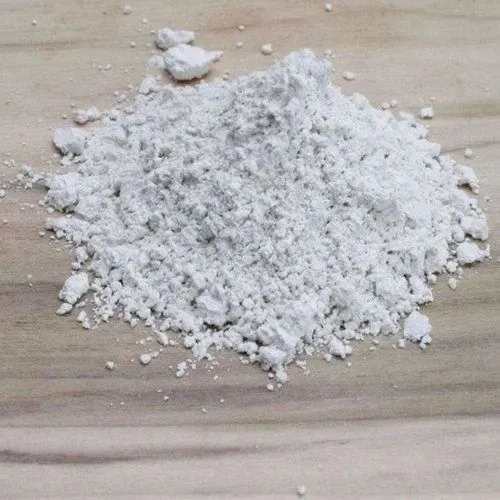
What is Kaolin Clay?
Kaolin clay (also known as china clay) is a naturally occurring industrial mineral composed primarily of hydrated aluminum silicate. It is widely processed into fine powder or granules for industrial applications due to its:
- High whiteness and brightness
- Chemical stability
- Excellent heat resistance
- Fine particle size
- Low abrasiveness
Because of these properties, kaolin clay granules are considered a high-performance functional mineral used across multiple manufacturing industries.
Key Properties of Kaolin Clay Granules
Kaolin clay is preferred in industrial applications because it offers:
- High thermal stability (resistant to high temperatures)
- Excellent plasticity in ceramic processing
- Strong reinforcing ability in polymers and rubber
- Good dispersion in liquid and solid matrices
- Low shrinkage during firing or drying
- High opacity and brightness contribution
These properties make it one of the most versatile industrial mineral fillers in modern manufacturing.
Top 7 Industrial Uses of Kaolin Clay Granules
1. Ceramic Manufacturing Industry
Kaolin clay granules are essential in ceramics for improving strength, whiteness, and shaping ability.
They are widely used in the production of:
- Tiles
- Sanitaryware
- Porcelain
- Tableware
Why kaolin is used in ceramics:
- Improves plasticity for easy shaping
- Enhances whiteness and surface finish
- Maintains structure during firing
- Reduces cracking and shrinkage
Result: High-quality ceramic products with smooth texture and durability.
2. Rubber Industry
Kaolin clay acts as a reinforcing filler in rubber compounding applications.
It is commonly used in:
- Tires
- Footwear soles
- Industrial rubber parts
- Conveyor belts
Benefits in rubber:
- Increases tensile strength
- Improves wear resistance
- Enhances flexibility and elasticity
- Reduces production cost by replacing expensive fillers
Result: Stronger, more durable, and cost-efficient rubber products.
3. Construction Industry
Kaolin clay granules are widely used in construction materials engineering.
Applications include:
- Cement formulations
- Concrete additives
- Bricks and blocks
- Wall finishing materials
Benefits in construction:
- Improves compressive strength
- Enhances workability of mixtures
- Provides smoother surface finishing
- Increases long-term durability
Result: More stable and high-performance construction materials.
4. Paints and Coatings Industry
Kaolin clay is an important functional extender in paint formulations.
It is used in:
- Decorative paints
- Industrial coatings
- Protective coatings
Why it is used:
- Increases opacity and brightness
- Improves surface smoothness
- Enhances weather resistance
- Reduces formulation cost
Result: Better coverage, consistency, and long-lasting coatings.
5. Paper Manufacturing Industry
Kaolin clay is one of the most important minerals in the paper industry.
It is used in:
- Printing paper
- Coated paper
- Packaging paper
Benefits in paper production:
- Improves whiteness and brightness
- Enhances ink absorption and print quality
- Increases smoothness of paper surface
- Improves opacity
Result: High-quality printable paper with sharp image reproduction.
6. Refractory Applications (High-Temperature Industry)
Kaolin clay granules are widely used in heat-resistant industrial materials.
Applications include:
- Furnace linings
- Kiln bricks
- Heat-resistant ceramics
- Steel and cement plant equipment
Key advantages:
- Withstands extremely high temperatures
- Maintains structural stability under heat
- Resists thermal deformation
- Provides long operational life
Result: Reliable performance in extreme industrial environments.
7. Adhesives and Sealants Industry
Kaolin clay is used as a rheology modifier and filler in adhesives and sealants.
Applications include:
- Construction adhesives
- Industrial bonding agents
- Sealants for infrastructure
Benefits:
- Improves viscosity and consistency
- Enhances bonding strength
- Reduces shrinkage and cracking
- Improves product stability
Result: Stronger and more stable adhesive formulations.
Why Kaolin Clay Demand is Increasing Globally?
The demand for kaolin clay granules is rising due to:
- Growth in construction and infrastructure projects
- Expansion of automotive and rubber industries
- Increasing demand for high-quality ceramics
- Rising need for cost-effective industrial fillers
- Shift toward high-performance materials
Kaolin clay has become a critical industrial mineral in global manufacturing supply chains.
Kaolin Clay vs Other Industrial Fillers
| Property | Kaolin Clay | Calcium Carbonate | Talc |
|---|---|---|---|
| Whiteness | High | Medium | Medium |
| Heat Resistance | High | Low | Medium |
| Reinforcement Strength | High | Medium | Medium |
| Cost Efficiency | Medium | High | Medium |
| Industrial Use Range | Very Wide | Limited | Moderate |
Kaolin clay offers the best balance of performance, stability, and versatility.
Why Choose Green Trade India?
At Green Trade India, we supply premium-grade kaolin clay granules designed for industrial performance and consistency.
Our strengths:
- High-purity mineral processing
- Controlled particle size distribution
- Reliable bulk supply capability
- Consistent quality for industrial applications
- Fast and professional B2B delivery support
Our kaolin clay products are widely used in ceramics, rubber, construction, coatings, paper, and refractory industries.
Final Conclusion
Kaolin clay granules are one of the most versatile and high-demand industrial minerals in the world. From ceramics and rubber to construction and refractories, their unique combination of whiteness, stability, heat resistance, and reinforcement properties makes them indispensable in modern manufacturing.
As global industries continue to expand, kaolin clay will remain a key raw material powering high-performance, cost-efficient production systems.
FAQs
1. What is kaolin clay used for in industries?
Kaolin clay is used in ceramics, rubber, construction, paper, paints, coatings, adhesives, and refractory applications due to its strength, whiteness, and heat resistance.
2. Why is kaolin clay important in ceramics?
Kaolin clay improves plasticity, whiteness, and structural strength, making it essential for producing tiles, porcelain, and sanitaryware.
3. Is kaolin clay used in rubber manufacturing?
Yes, it is used as a reinforcing filler that improves strength, durability, flexibility, and cost efficiency of rubber products.
4. Can kaolin clay withstand high temperatures?
Yes, kaolin clay has excellent thermal stability and is widely used in refractory applications like kiln linings and furnace bricks.
5. Is kaolin clay suitable for construction materials?
Yes, it improves strength, workability, and durability of cement, concrete, bricks, and other construction materials.