


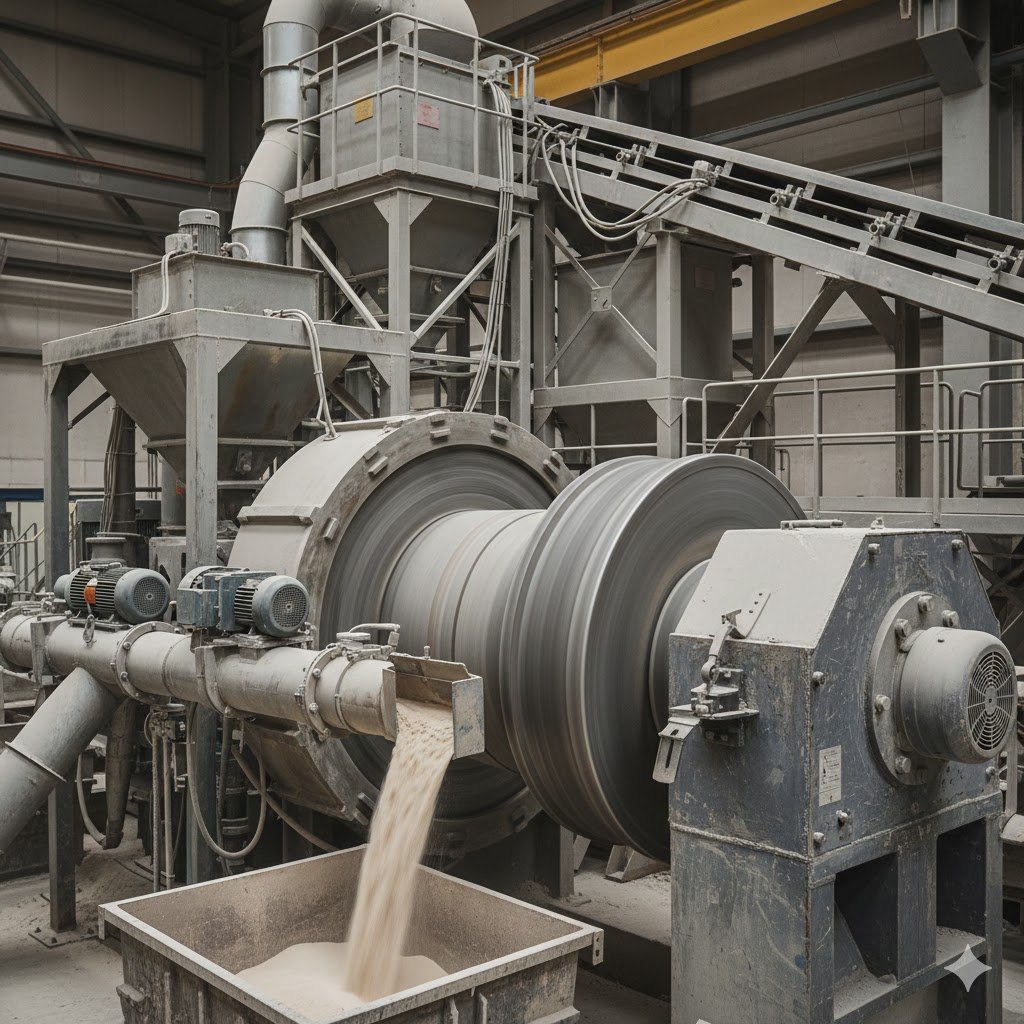
Kaolin clay is a mineral filler used in selected plastic and rubber formulations to help improve properties such as stiffness, dimensional stability, surface appearance, opacity, mechanical performance and processing consistency. Its effectiveness depends on the kaolin grade, particle size, dispersion, loading level, polymer or rubber system, and manufacturing process.
In plastics, kaolin can be used in applications such as PVC products, plastic sheets, masterbatch, molded components and selected electrical or cable compounds. In rubber manufacturing, it can be incorporated into formulations for hoses, belts, seals, molded rubber products and other technical rubber goods.
For manufacturers, selecting the right kaolin grade is important because filler performance depends on the specific formulation and finished-product requirements.
Quick Answer: What Is Kaolin Clay Used for in Plastics and Rubber?
Kaolin clay is used as a functional mineral filler in plastics and rubber formulations. Depending on the grade and formulation, it can contribute to stiffness, dimensional stability, surface properties, opacity, dispersion, mechanical performance and formulation cost optimization.
| Application | Potential Role of Kaolin |
|---|---|
| PVC products | Stiffness, dimensional stability and surface properties |
| Plastic sheets | Surface appearance and dimensional stability |
| Masterbatch | Filler incorporation and formulation optimization |
| Molded plastics | Stiffness and processing consistency |
| Rubber compounds | Mechanical properties and compound stability |
| Hoses | Compound consistency and dimensional stability |
| Belts | Durability and formulation performance |
| Seals | Stability and compound consistency |
| Molded rubber products | Mechanical and processing properties |
The actual performance depends on the kaolin grade, particle characteristics, loading level, formulation and processing conditions.
What Is Kaolin Clay?
Kaolin is a naturally occurring clay mineral that is processed into different grades for industrial applications. Its characteristics can include controlled particle size, particle-size distribution, brightness, moisture level and surface properties.
These characteristics make kaolin useful as a mineral or functional filler in several industries, including plastics, rubber, paints and coatings, paper, ceramics and other industrial applications.
For plastics and rubber, manufacturers generally evaluate kaolin based on how its physical and chemical characteristics interact with the formulation and the required properties of the final product.
Why Is Kaolin Used as a Mineral Filler?
Manufacturers use mineral fillers to modify product properties, optimize formulations, and manage production costs. Kaolin can be considered when a formulation requires a combination of physical performance, appearance, processing characteristics, and cost efficiency.
Important factors that influence kaolin's suitability include:
- Particle size and particle-size distribution
- Brightness
- Moisture content
- Dispersion characteristics
- Surface characteristics
- Compatibility with the polymer or rubber system
- Filler loading level
- Processing method
- Required finished-product properties
A suitable kaolin grade can help manufacturers achieve more consistent results while meeting specific product specifications.
Kaolin Clay in Plastics: Applications and Benefits
Kaolin is used in selected plastic formulations as a mineral filler to modify properties such as stiffness, dimensional stability, surface characteristics and opacity.
Its suitability depends on the type of polymer, processing method and performance requirements.
1. Kaolin for PVC Products
PVC is one of the important polymer systems in which mineral fillers can be used. Kaolin may be incorporated into selected rigid or flexible PVC formulations depending on the desired properties.
Potential applications include:
- PVC pipes and profiles
- PVC sheets
- Selected flooring applications
- Cable and electrical compounds
- Molded PVC components
- Other PVC-based products
Depending on the formulation and grade, kaolin can contribute to stiffness, dimensional stability, surface properties and opacity.
Manufacturers should evaluate the filler together with the complete PVC formulation rather than selecting a grade based on price alone.
2. Kaolin for Plastic Sheets
Kaolin can be used in selected plastic sheet formulations where manufacturers are looking to optimize characteristics such as:
- Surface appearance
- Dimensional stability
- Stiffness
- Opacity
- Processing consistency
Particle size and dispersion are particularly important when surface quality is a key product requirement.
3. Kaolin for Masterbatch
Masterbatch manufacturers may evaluate kaolin as part of their filler or additive formulation depending on the end application.
The important selection parameters can include:
- Particle size
- Dispersion
- Moisture
- Compatibility
- Loading level
- Processing conditions
The appropriate grade should be validated within the actual masterbatch formulation to ensure consistent processing and final-product performance.
4. Kaolin for Molded Plastic Products
Kaolin can be incorporated into selected molded plastic products to modify stiffness, dimensional behavior and surface characteristics.
Potential applications include molded household products, industrial components and other plastic parts where the formulation requires a mineral filler.
5. Kaolin in Electrical and Cable Compounds
Kaolin can also be evaluated for selected electrical and cable-related polymer compounds.
However, electrical, thermal and mechanical requirements vary significantly between applications. Therefore, kaolin suitability should be determined through formulation testing and relevant product specifications rather than assuming that one grade is appropriate for every cable compound.
What Are the Benefits of Kaolin in Plastics?
Depending on the polymer system and formulation, kaolin can offer several potential benefits.
Improved Stiffness
Kaolin can contribute to increased stiffness in selected polymer formulations, which may be useful when a more rigid finished product is required.
Dimensional Stability
Mineral fillers can influence dimensional behavior during processing and cooling. Kaolin may therefore be considered where dimensional consistency is important.
Surface Appearance
Fine and appropriately dispersed kaolin grades can contribute to surface characteristics in selected plastic products.
Opacity
Kaolin's optical properties can be useful in applications where opacity and finished-product appearance are important.
Processing Consistency
A kaolin grade with controlled particle characteristics and good dispersion can support consistent processing when properly incorporated into the formulation.
Formulation Cost Optimization
Mineral fillers can be used as part of a formulation strategy to balance performance and material cost. The optimum loading level depends on the required product specifications.
Kaolin Clay in Rubber: Applications and Benefits
Kaolin is also used as a mineral filler in selected rubber compounds. Depending on the rubber system, grade and loading level, it can contribute to mechanical properties, dimensional stability, processing behaviour and formulation economics.
Applications can include:
- Rubber hoses
- Belts
- Seals
- Gaskets
- Molded rubber products
- Industrial rubber components
- Technical rubber goods
Kaolin for Rubber Compounds
Rubber manufacturers evaluate fillers based on the properties required from the finished compound.
Important performance parameters can include:
- Tensile strength
- Tear resistance
- Abrasion resistance
- Hardness
- Modulus
- Elongation
- Dimensional stability
- Dispersion
- Processing behaviour
Kaolin performance varies by grade and formulation. Therefore, manufacturers should test the selected kaolin in the intended rubber compound before moving to large-scale production.
How Does Kaolin Improve Rubber Performance?
Kaolin can contribute to the mechanical and processing performance of selected rubber compounds. Depending on the formulation, it may help support properties such as tensile strength, tear resistance, abrasion resistance, compound consistency, and dimensional stability.
1. Tensile and Mechanical Properties
Certain kaolin grades can contribute to mechanical performance when properly dispersed within a compatible rubber formulation.
2. Tear Resistance
In selected rubber compounds, kaolin may contribute to tear resistance and overall compound performance.
3. Abrasion Resistance
Kaolin can be considered where abrasion resistance is an important requirement, although the final result depends on the rubber type, filler grade, loading and complete formulation.
4. Dimensional Stability
Mineral fillers can influence the dimensional behavior of rubber products and may be useful in applications requiring consistent dimensions.
5. Processing Characteristics
Good filler dispersion is important for achieving consistent compound properties. Kaolin particle characteristics can therefore be an important part of filler selection.
Which Rubber Products Can Use Kaolin?
Kaolin may be incorporated into various industrial rubber formulations, including:
Rubber Hoses
Used in formulations where mechanical performance, flexibility and dimensional stability are required.
Rubber Belts
Kaolin can be evaluated as part of formulations designed for durability and mechanical performance.
Seals and Gaskets
Selected kaolin grades can be considered where dimensional stability and compound consistency are important.
Molded Rubber Products
Kaolin can be incorporated into selected molded rubber formulations to modify physical and processing properties.
Technical Rubber Products
Industrial rubber components may use mineral fillers as part of a broader formulation strategy.
The suitability of kaolin should always be evaluated against the specific rubber polymer, additives, processing conditions and finished-product specifications.
Kaolin vs Calcium Carbonate: Which Mineral Filler Is Better?
There is no universal answer to whether kaolin or calcium carbonate is the better filler. The appropriate choice depends on the polymer or rubber system, required properties, particle characteristics, processing method, loading level and cost target.
| Factor | Kaolin | Calcium Carbonate |
|---|---|---|
| Primary role | Functional/mineral filler | Mineral filler |
| Stiffness contribution | Formulation dependent | Formulation dependent |
| Surface properties | Grade dependent | Grade dependent |
| Opacity | Can contribute | Can contribute |
| Particle characteristics | Grade dependent | Grade dependent |
| Rubber applications | Formulation dependent | Formulation dependent |
| Best choice | Depends on application | Depends on application |
For manufacturers, filler selection should be based on technical requirements rather than price or filler name alone.
How to Choose the Right Kaolin Grade for Plastics and Rubber
Choosing the right kaolin grade is one of the most important steps in achieving consistent product performance.
A practical selection process is:
Application → Polymer/Rubber → Processing Method → Required Properties → Filler Loading → Kaolin Grade → Production Testing
For Plastic Applications
Consider:
- Particle size
- Particle-size distribution
- Brightness
- Moisture
- Dispersion
- Polymer compatibility
- Required stiffness
- Surface finish
- Opacity
- Processing temperature
- Filler loading
For Rubber Applications
Consider:
- Particle size
- Particle-size distribution
- Dispersion
- Rubber-polymer compatibility
- Tensile requirements
- Tear resistance
- Abrasion requirements
- Hardness
- Modulus
- Loading level
- Processing conditions
A grade that works well in one formulation may not deliver the same result in another. Laboratory trials and production validation are therefore important before finalizing a kaolin grade.
What Should Manufacturers Check Before Buying Kaolin?
Industrial buyers should evaluate more than the quoted price when sourcing kaolin.
Before purchasing, consider asking for:
- Particle-size specifications
- Particle-size distribution
- Brightness data
- Moisture specifications
- Chemical composition
- Dispersion characteristics
- Surface treatment information, where applicable
- Recommended applications
- Technical data sheets
- Sample availability
- Batch-to-batch consistency
- Packaging and bulk supply options
Consistent specifications are particularly important for manufacturers operating large-scale production because changes in filler characteristics can affect processing and finished-product quality.
Common Mistakes When Selecting Kaolin Filler
Choosing Kaolin Only on Price
The lowest-cost filler may not provide the required performance or processing characteristics. Total formulation cost should be considered alongside technical performance.
Ignoring Particle Size
Particle size and particle-size distribution can influence dispersion, surface properties and formulation behavior.
Using the Same Grade for Every Application
Different polymers, rubber compounds and manufacturing processes have different requirements. A single kaolin grade may not be suitable for every application.
Overlooking Moisture
Moisture can influence processing and formulation consistency, making it an important specification to review.
Not Testing Dispersion
Good dispersion is essential for consistent filler performance. Manufacturers should validate dispersion in the actual formulation.
Assuming Higher Loading Always Means Better Performance
Increasing filler loading can change mechanical properties, processing behavior and surface characteristics. The optimum level must be determined for the specific formulation.
Industries That Use Kaolin Mineral Fillers
Kaolin-based mineral fillers can be evaluated across multiple industrial sectors, including:
- Plastic manufacturing
- PVC manufacturing
- Rubber manufacturing
- Masterbatch production
- Cable and polymer compounds
- Automotive components
- Industrial hoses
- Seals and gaskets
- Belts
- Molded rubber products
- Plastic sheets
- Industrial molded products
The technical requirements vary significantly across industries, making grade selection and application testing important.
Why Choose Green Trade India for Industrial Kaolin?
Green Trade India supplies kaolin-based mineral solutions for manufacturers evaluating fillers for plastic, rubber, and other industrial applications.
For industrial buyers, consistent material specifications are important for maintaining predictable production performance. Green Trade India focuses on supplying kaolin with controlled characteristics suited to different application requirements.
When selecting a kaolin supplier, manufacturers can evaluate factors such as:
- Product consistency
- Particle-size control
- Quality specifications
- Laboratory testing
- Packaging options
- Bulk supply capability
- Export requirements
- Application-specific grade selection
- Technical documentation
Rather than selecting a filler solely based on cost, manufacturers can work with Green Trade India to identify a kaolin solution based on their application, formulation requirements, and target product properties.
Conclusion
Kaolin clay is a versatile mineral filler that can support the performance and formulation requirements of selected plastic and rubber products. In plastics, it can contribute to properties such as stiffness, dimensional stability, surface appearance, and opacity. In rubber, it can contribute to mechanical performance, abrasion resistance, dimensional stability, and processing consistency.
However, kaolin performance depends strongly on grade selection, particle characteristics, dispersion, loading level, polymer or rubber compatibility and processing conditions.
For manufacturers, the right approach is to select kaolin based on the specific application rather than using a one-size-fits-all grade. Green Trade India can support industrial buyers looking for kaolin solutions for plastic, rubber, and related applications.
Looking for kaolin for plastics or rubber manufacturing? Contact Green Trade India to discuss your application, required specifications, grade requirements and bulk supply needs.
Request Kaolin Specifications | Ask for a Sample | Contact Green Trade India
Kaolin Clay in Plastics & Rubber: Frequently Asked Questions
1. What is kaolin clay used for in plastics?
Kaolin clay is used as a mineral filler in selected plastic formulations. Depending on the grade and formulation, it can contribute to stiffness, dimensional stability, surface characteristics, opacity and processing consistency.
2. What is kaolin clay used for in rubber?
Kaolin clay is used as a mineral filler in selected rubber compounds. It can contribute to mechanical properties, abrasion resistance, dimensional stability, compound consistency and processing characteristics, depending on the formulation.
3. What are the main benefits of kaolin in plastics?
The potential benefits include improved stiffness, dimensional stability, surface characteristics and opacity. Kaolin can also be used as part of a formulation strategy for material-cost optimization.
4. How does kaolin improve rubber performance?
Depending on the rubber system and grade, kaolin can contribute to tensile strength, tear resistance, abrasion resistance, dimensional stability and compound consistency.
5. Is kaolin a reinforcing filler for rubber?
Kaolin can function as a reinforcing or semi-reinforcing mineral filler in selected rubber formulations, depending on its grade, particle characteristics, loading level and the rubber system.
6. What types of rubber can use kaolin clay?
Kaolin can be evaluated in natural rubber and various industrial rubber formulations. Applications may include hoses, belts, seals, gaskets, molded rubber products and technical rubber goods.
7. Can kaolin be used in PVC?
Yes. Kaolin can be incorporated into selected PVC formulations, including certain rigid and flexible PVC applications. The appropriate grade depends on the required properties, processing method and overall formulation.
8. Can kaolin be used in plastic masterbatch?
Kaolin can be used in selected masterbatch formulations. Particle size, dispersion, moisture, compatibility and loading level should be evaluated to determine whether a particular kaolin grade is suitable.
9. Does kaolin improve plastic stiffness?
Kaolin can contribute to increased stiffness in selected plastic formulations. The degree of improvement depends on the polymer, kaolin grade, loading level, dispersion, and processing conditions.
10. How do manufacturers choose the right kaolin grade?
Manufacturers should consider particle size, particle-size distribution, brightness, moisture, dispersion, compatibility, loading level, processing conditions and the required properties of the finished product.
11. What should industrial buyers check before purchasing kaolin?
Buyers should review technical specifications such as particle size, particle-size distribution, brightness, moisture, chemical composition, dispersion characteristics, batch consistency, packaging and application suitability.
12. Is kaolin better than calcium carbonate as a filler?
Neither filler is universally better. Kaolin and calcium carbonate have different characteristics, and the appropriate choice depends on the polymer or rubber system, target properties, processing method, loading level, and cost requirements.