


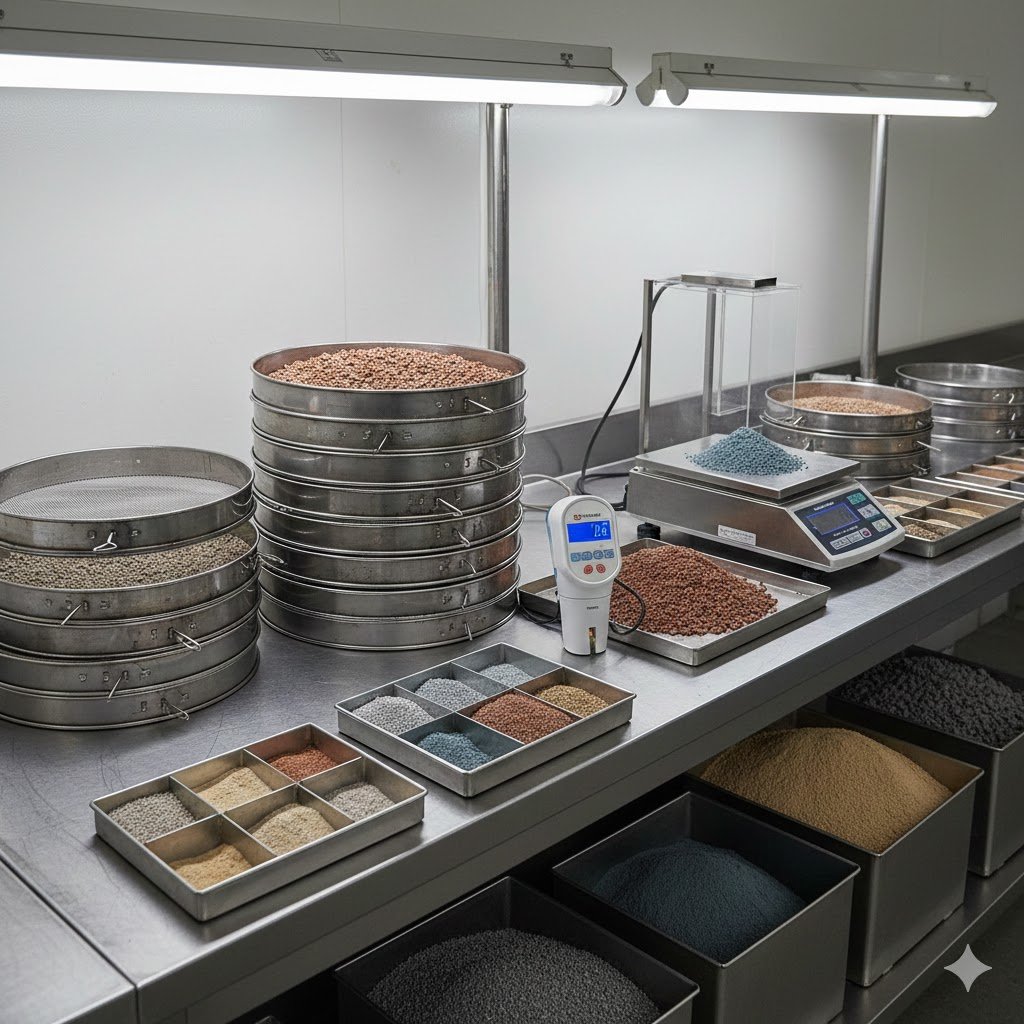
Kaolin clay is a widely used industrial mineral valued for its high whiteness, chemical stability, and fine particle size. It plays an essential role in industries such as ceramics, paper, paints, rubber, cosmetics, and pharmaceuticals. Because the performance of finished products heavily depends on the quality of raw materials, kaolin clay quality testing is a critical step before industrial use.
At Green Trade India, every batch of kaolin clay undergoes detailed laboratory analysis to ensure purity, consistency, and compliance with industrial standards. Understanding how to test kaolin clay quality helps manufacturers select the right grade of material for their specific applications.
Quick Summary: How to Test Kaolin Clay Quality
Kaolin clay quality is typically tested through several laboratory methods that evaluate its physical and chemical properties. The most common tests include chemical composition analysis using X-ray fluorescence (XRF), particle size distribution measurement using laser diffraction, brightness and whiteness evaluation using spectrophotometers, moisture content analysis using oven-drying methods, and pH level testing with impurity detection.
Why Kaolin Clay Quality Testing is Important?
Kaolin clay is used in many industries where raw material purity directly affects the final product. Even small variations in mineral composition, particle size, or moisture content can significantly influence product performance.
- Ensure consistent raw material quality
- Reduce production defects and rejection rates
- Maintain compliance with industrial standards
- Improve the performance of finished products
Key Parameters Used to Test Kaolin Clay Quality
1. Particle Size Distribution
Fine particles improve surface smoothness, coating performance, and suspension stability.
2. Chemical Composition
Kaolin clay primarily contains aluminum oxide and silicon dioxide. Chemical analysis helps determine purity and identify impurities such as iron oxide or titanium dioxide.
3. Brightness and Whiteness Index
Higher brightness indicates better optical quality for paper coating, paints, and cosmetics.
4. Moisture Content
Moisture levels affect storage stability and handling characteristics. Excess moisture can lead to clumping and reduced efficiency.
5. pH Level
The pH value of kaolin clay determines compatibility with coatings, pharmaceuticals, and other chemical formulations.
6. Mineral Impurities
Impurities such as quartz, mica, and iron minerals may affect product color and performance.
Laboratory Methods Used in Kaolin Clay Testing
X-Ray Fluorescence (XRF) Analysis
XRF identifies the concentration of major elements such as aluminum, silicon, iron, and titanium.
Particle Size Analysis
Laser diffraction particle size analyzers provide highly accurate distribution data for industrial applications.
Brightness and Whiteness Measurement
Spectrophotometers under controlled lighting conditions are used to evaluate optical properties.
Moisture Content Testing
Moisture content is measured using oven-drying techniques or moisture analyzers.
pH Testing
Standard laboratory pH meters determine chemical stability and formulation compatibility.
Industrial Standards for Kaolin Clay Testing
Kaolin clay testing often follows standards developed by ASTM International, the International Organization for Standardization, and the Bureau of Indian Standards. Following recognized standards helps manufacturers maintain consistency and meet regulatory requirements.
Typical Industrial Kaolin Clay Specifications
| Parameter | Typical Value |
|---|---|
| Brightness | 85-92% |
| Particle Size | <2 microns |
| Moisture Content | <1% |
| pH Level | 4.5 - 6.5 |
| Al₂O₃ Content | 35-39% |
Industries That Require High-Quality Kaolin Clay
- Ceramic Manufacturing: Improves plasticity, strength, and firing behavior
- Paper Industry: Enhances brightness, smoothness, and print quality
- Paints and Coatings: Provides opacity, durability, and improved performance
- Rubber Processing: Acts as a reinforcing filler
- Cosmetics and Skincare: Offers gentle cleansing properties and high purity
- Pharmaceutical Applications: Requires strict purity standards
How Green Trade India Ensures High-Quality Kaolin Supply
Our quality control process includes detailed chemical composition analysis, particle size distribution measurement, brightness and whiteness evaluation, moisture and pH testing, and batch documentation with quality certification.
Frequently Asked Questions (FAQs)
1. What are the key parameters used to test kaolin clay quality?
The most important parameters include particle size distribution, chemical composition, brightness, whiteness index, moisture content, and pH level. These properties determine the purity and industrial performance of kaolin clay.
2. Which laboratory tests determine kaolin clay purity?
Common laboratory tests include X-ray fluorescence (XRF) analysis for chemical composition and particle size analysis using laser diffraction. These methods help identify mineral content and impurities.
3. How is brightness and whiteness of kaolin clay measured?
Brightness and whiteness are measured using spectrophotometers under controlled lighting conditions. These tests are particularly important for the paper, paint, and cosmetic industries.
4. What is the standard method for particle size analysis?
Laser diffraction particle size analysis is the most commonly used method. It provides precise measurement of particle distribution in kaolin clay samples.
5. How is moisture content tested in kaolin clay?
Moisture content is typically measured using oven-drying techniques or electronic moisture analyzers. Controlling moisture levels helps maintain material stability during storage and processing.