


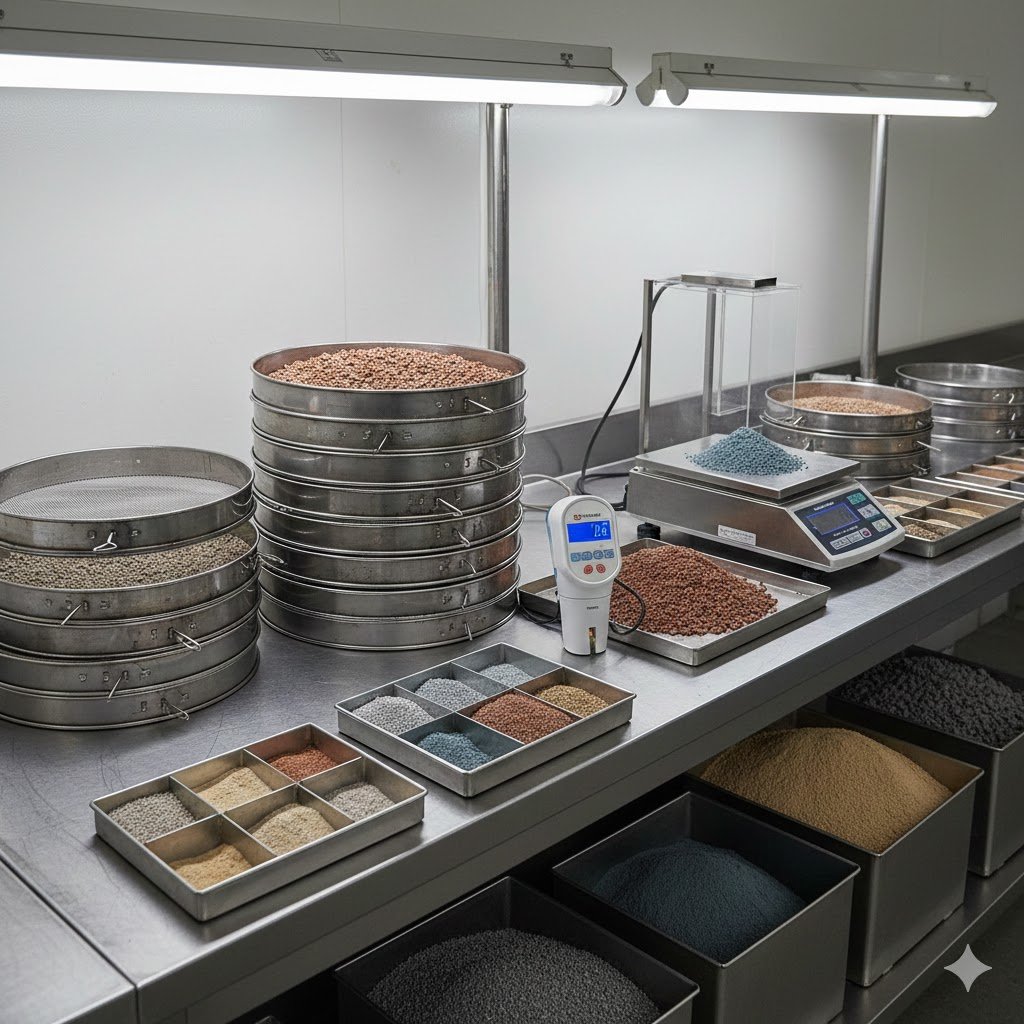
Kaolin clay is one of the most important industrial minerals used in ceramics, paper manufacturing, paints, coatings, rubber, plastics, cosmetics, and pharmaceutical applications. The performance of finished products depends heavily on the purity, particle size, chemical composition, and consistency of the kaolin used during production.
Because even minor variations in raw material quality can affect manufacturing performance, kaolin quality testing is an essential part of industrial procurement and quality assurance. Manufacturers rely on laboratory analysis and industry standards to verify that kaolin meets specific application requirements.
In this guide, you'll learn how kaolin clay quality is tested, what analytical properties define industrial kaolin specifications, how particle size distribution affects performance, and what factors to evaluate when selecting high-purity kaolin suppliers.
Quick Answer: How Is Kaolin Clay Quality Tested?
Kaolin clay quality is evaluated through laboratory testing that measures particle size distribution, chemical composition, brightness, whiteness, moisture content, pH level, and mineral impurities. Common testing methods include X-Ray Fluorescence (XRF), laser diffraction particle size analysis, spectrophotometer brightness testing, moisture analysis, and mineralogical examination.
These analytical properties help manufacturers determine whether a kaolin grade is suitable for paper coating, ceramics, paints, rubber products, cosmetics, or pharmaceutical formulations.
What Are the Key Analytical Properties Used to Specify Industrial Kaolin?
Industrial kaolin specifications are primarily based on measurable physical and chemical properties that directly influence product performance.
The key analytical properties used to specify industrial kaolin include:
1. Particle Size Distribution
Particle size distribution (PSD) is one of the most important quality indicators for kaolin clay.
Kaolin particle size distribution measures the percentage of particles within specific size ranges. Fine particle distributions improve:
- Surface smoothness
- Coating performance
- Suspension stability
- Opacity
- Printability
- Product consistency
Many industrial specifications focus on the percentage of particles smaller than 2 microns because this significantly affects performance in paper, coatings, and specialty applications.
2. Chemical Composition
Kaolin primarily consists of hydrated aluminum silicate. Chemical composition analysis determines purity and identifies undesirable contaminants.
Typical components include:
| Component | Typical Range |
|---|---|
| Aluminum Oxide (Al₂O₃) | 35–39% |
| Silicon Dioxide (SiO₂) | 45–50% |
| Iron Oxide (Fe₂O₃) | <1% |
| Titanium Dioxide (TiO₂) | Trace |
Lower impurity levels generally indicate higher-quality kaolin suitable for demanding industrial applications.
3. Brightness and Whiteness
Brightness and whiteness determine the optical quality of kaolin. These properties are particularly important for:
- Paper coating
- Decorative paints
- Plastic fillers
- Cosmetic products
- Pharmaceutical formulations
Higher brightness values often indicate greater purity and improved commercial value.
4. Mineralogical Composition
Industrial buyers often evaluate mineral composition to confirm kaolinite content and detect impurities such as:
- Quartz
- Mica
- Feldspar
- Iron-bearing minerals
- Titanium minerals
Mineralogical analysis helps ensure consistency and suitability for specific manufacturing processes.
5. Moisture Content
Moisture content affects storage stability, material handling, transportation efficiency, and processing performance. Excess moisture can lead to clumping, reduced flowability, and inconsistent production results.
6. pH Value
The pH level influences compatibility with coatings, adhesives, pharmaceuticals, cosmetics, and chemical formulations. Most industrial kaolin grades typically fall within a pH range of 4.5 to 6.5.
Why Kaolin Clay Quality Testing Is Important?
Industrial manufacturers depend on consistent raw materials to maintain product quality and production efficiency. Kaolin quality testing helps:
- Verify raw material purity
- Reduce production defects
- Improve manufacturing consistency
- Meet customer specifications
- Ensure regulatory compliance
- Minimize product rejection rates
- Optimize formulation performance
Without proper testing, impurities or inconsistent particle sizes can negatively impact final product quality.
Understanding Kaolin Particle Size Distribution
What Is Kaolin Particle Size Distribution?
Kaolin particle size distribution refers to the proportion of particles present across different size ranges within a sample. Particle size directly affects how kaolin performs in various applications.
Paper Industry
Fine kaolin particles improve paper brightness, surface smoothness, ink receptivity, and print quality.
Paints and Coatings
Controlled particle size distributions enhance opacity, suspension stability, surface finish, and durability.
Ceramics
Proper kaolin clay particle size improves plasticity, green strength, firing performance, and dimensional stability.
Rubber and Plastics
Fine particle grades provide better reinforcement, improved dispersion, and enhanced mechanical properties.
Because of its significant impact on product performance, kaolin particle size distribution remains one of the most critical specifications in industrial mineral testing.
Laboratory Methods Used for Kaolin Quality Testing
1. X-Ray Fluorescence (XRF) Analysis
XRF testing determines elemental composition and measures concentrations of aluminum, silicon, iron, titanium, calcium, and potassium. This method is widely used for kaolin purity analysis and quality control.
2. Laser Diffraction Particle Size Analysis
Laser diffraction technology provides highly accurate particle size distribution data. The technique measures mean particle size, distribution range, percentage below 2 microns, and particle uniformity. It is considered the industry standard for kaolin clay particle size analysis.
3. Brightness and Whiteness Testing
Spectrophotometers evaluate optical properties under controlled conditions. Results are used to determine suitability for paper manufacturing, paint formulations, and cosmetic applications.
4. Moisture Analysis
Moisture content is commonly measured through oven drying methods, infrared moisture analyzers, and digital moisture testing equipment.
5. pH Testing
Laboratory pH meters measure acidity and alkalinity levels to ensure compatibility with downstream applications.
6. Mineralogical Analysis
X-Ray Diffraction (XRD) is frequently used to identify mineral phases and quantify impurities within kaolin deposits.
Industrial Standards for Kaolin Testing
Industrial kaolin testing typically follows internationally recognized quality standards. Common standards include:
- ASTM Standards
- ISO Standards
- Bureau of Indian Standards (BIS)
- Industry-specific quality protocols
Following established standards ensures consistency, comparability, and compliance across industries.
Typical Industrial Kaolin Specifications
| Parameter | Typical Value |
|---|---|
| Brightness | 85–92% |
| Particle Size | <2 Microns |
| Moisture Content | <1% |
| pH Level | 4.5–6.5 |
| Al₂O₃ Content | 35–39% |
Actual specifications vary depending on the intended application and required performance characteristics.
Factors to Evaluate High-Purity Kaolin Suppliers
Selecting the right supplier is just as important as selecting the right grade. When evaluating high-purity kaolin suppliers, consider the following factors:
1. Consistent Quality Control
Reliable suppliers perform routine laboratory testing on every production batch.
2. Verified Particle Size Distribution Reports
Suppliers should provide documented particle size distribution data that matches application requirements.
3. Chemical Purity Documentation
Request Certificates of Analysis (COA) showing aluminum oxide content, iron content, titanium content, and moisture levels.
4. Industry Certifications
Look for suppliers that maintain compliance with recognized testing and quality standards.
5. Traceability and Batch Documentation
Batch-level documentation helps ensure product consistency and quality assurance.
6. Technical Support
Experienced suppliers can recommend suitable grades for specific applications and processing requirements.
7. Reliable Supply Capacity
Consistent inventory and logistics support are essential for uninterrupted manufacturing operations.
Industries That Require High-Quality Kaolin Clay
- Ceramic Manufacturing: Improves plasticity, strength, and firing behavior.
- Paper Industry: Enhances brightness, printability, and coating performance.
- Paints and Coatings: Provides opacity, smoothness, and durability.
- Rubber Processing: Acts as a reinforcing and functional filler.
- Cosmetics and Personal Care: Requires high purity and controlled particle size.
- Pharmaceutical Applications: Demands strict quality control and contamination management.
How Green Trade India Ensures Kaolin Quality
At Green Trade India, every batch of kaolin undergoes comprehensive laboratory analysis before shipment. Our quality assurance process includes:
- Particle size distribution testing
- XRF chemical composition analysis
- Brightness and whiteness evaluation
- Moisture content measurement
- pH testing
- Batch traceability documentation
- Certificate of Analysis (COA) generation
This systematic approach ensures customers receive consistent, high-quality kaolin suitable for industrial applications.
Conclusion
Kaolin clay quality testing is essential for ensuring consistent industrial performance and product quality. The most important analytical properties used in industrial kaolin specification include particle size distribution, chemical composition, brightness, whiteness, moisture content, pH level, and mineral purity.
Understanding these quality parameters allows manufacturers to select the appropriate grade, optimize production processes, and confidently evaluate high-purity kaolin suppliers for long-term procurement success.
Kaolin Products
Kaolin Powder | Kaolin Noodles | Kaolin Granules
Frequently Asked Questions (FAQs)
1. What are the key analytical properties used to specify industrial kaolin?
The primary analytical properties include particle size distribution, chemical composition, brightness, whiteness, moisture content, pH level, and mineral impurity analysis.
2. Why is kaolin particle size distribution important?
Particle size distribution affects coating performance, surface smoothness, opacity, plasticity, suspension stability, and overall product quality.
3. What is the standard method for kaolin clay particle size analysis?
Laser diffraction is the most widely used method because it provides highly accurate and repeatable particle size distribution measurements.
4. How is kaolin purity analyzed?
Kaolin purity analysis is commonly performed using X-Ray Fluorescence (XRF) and mineralogical testing methods that identify elemental composition and impurities.
5. What factors should buyers evaluate when selecting high-purity kaolin suppliers?
Buyers should evaluate quality control systems, laboratory testing capabilities, particle size distribution reports, chemical purity documentation, certifications, supply reliability, and technical support.
6. Which industries require high-purity kaolin?
Industries including ceramics, paper, paints, rubber, plastics, cosmetics, and pharmaceuticals require carefully controlled, high-purity kaolin grades.