


Kaolinite and kaolin are closely related, but they are not exactly the same. Kaolinite is a specific clay mineral with the chemical formula Al₂Si₂O₅(OH)₄, while kaolin generally refers to a naturally occurring clay or clay-rich material composed predominantly of kaolin-group minerals, especially kaolinite. Because natural kaolin can contain other minerals, its composition, purity, brightness, particle size, and performance can vary depending on its geological source and processing.
Understanding the difference between kaolinite vs kaolin is important when selecting mineral raw materials for applications such as ceramics, paper, paints, coatings, plastics, rubber and other industrial processes.
Kaolinite vs Kaolin: Quick Difference
| Feature | Kaolinite | Kaolin |
|---|---|---|
| What is it? | A specific clay mineral | A naturally occurring clay or clay-rich material |
| Chemical formula | Al₂Si₂O₅(OH)₄ | Does not have one fixed formula because composition can vary |
| Mineral composition | Defined mineral species | Predominantly kaolin-group minerals, especially kaolinite |
| Purity | Refers to a specific mineral species | Depends on geological source and processing |
| Other minerals | Pure kaolinite has a defined composition | May contain quartz, mica, feldspar and other minerals |
| Commercial use | Primarily relevant as a mineral component | Widely used as an industrial raw material |
| Common applications | Contributes to the properties of kaolin and ceramic materials | Ceramics, paper, paints, coatings, plastics, rubber and more |
In simple terms:
Kaolinite is a mineral, while kaolin is a naturally occurring clay or clay-rich material that is predominantly made up of kaolin-group minerals, particularly kaolinite.
This is the key distinction when comparing kaolin vs kaolinite.
What Is Kaolinite?
Kaolinite is a naturally occurring clay mineral belonging to the kaolin group. Its chemical formula is Al₂Si₂O₅(OH)₄, giving it a defined mineral composition and structure.
Kaolinite has a layered structure consisting of alumina and silica sheets. It is typically associated with fine particle size, relatively low abrasiveness, chemical stability and a light or white appearance when present in sufficiently pure form.
Kaolinite commonly forms through the weathering or alteration of aluminosilicate minerals. It is an important constituent of many natural kaolin deposits and contributes significantly to the properties that make kaolin useful in industrial applications.
Kaolinite Chemical Formula
The chemical formula of kaolinite is:
Al₂Si₂O₅(OH)₄
Because kaolinite is a specific mineral species, its chemical composition is defined. This is different from natural kaolin, whose overall composition can vary depending on the deposit and processing.
What Is Kaolin?
Kaolin is a naturally occurring clay or clay-rich material composed predominantly of kaolin-group minerals, especially kaolinite.
The term kaolin is widely used in the minerals and industrial raw-material industries. Natural kaolin deposits can contain kaolinite along with smaller quantities of other minerals. Depending on its geological origin and beneficiation process, the final kaolin material may differ in mineral composition, particle-size distribution, brightness, moisture and other technical properties.
Commercial kaolin is therefore evaluated according to its actual specifications rather than simply its product name.
Kaolin is valued for properties such as:
- Fine particle size
- Brightness and whiteness
- Low abrasiveness
- Chemical stability
- Good dispersion characteristics
- Controlled particle-size distribution
- Useful surface and absorption properties
These characteristics make kaolin an important raw material in several manufacturing industries.
Kaolinite vs Kaolin: What Is the Main Difference?
The simplest way to understand the difference between kaolinite and kaolin is to consider the level at which each term is used.
Kaolinite identifies a specific mineral species. Kaolin generally describes a natural clay or clay-rich material that is predominantly composed of kaolin-group minerals, especially kaolinite.
Therefore, kaolinite can be a principal mineral component of kaolin, but the terms should not automatically be treated as synonyms.
This distinction becomes particularly important when purchasing or specifying industrial mineral materials. A commercially supplied kaolin product may contain other minerals, and its properties can change according to its source and processing history.
Kaolinite vs Kaolin: Composition and Chemical Formula
One of the clearest differences between kaolinite and kaolin is their chemical definition.
Kaolinite
Kaolinite has a defined chemical formula:
Al₂Si₂O₅(OH)₄
It represents a specific mineral species with a characteristic crystal structure.
Kaolin
Kaolin is a naturally occurring material rather than a single pure mineral species. Its exact mineralogical and chemical composition can therefore vary.
The amount of kaolinite and the presence of other minerals can depend on:
- Geological origin
- Degree of weathering
- Mineral formation conditions
- Mining location
- Beneficiation
- Washing and classification
- Refining and processing
For this reason, manufacturers should review the technical specification and certificate of analysis of a kaolin product instead of assuming that every kaolin material has identical composition.
Is Kaolinite the Same as Kaolin?
No. Kaolinite and kaolin are related but technically different terms.
Kaolinite is a specific clay mineral with a defined chemical composition. Kaolin refers to a natural clay or clay-rich material predominantly containing kaolin-group minerals, especially kaolinite.
The two terms are often used interchangeably in everyday conversations because kaolinite is the principal mineral associated with many kaolin deposits. However, for mineralogical and industrial applications, distinguishing between the mineral and the natural material is important.
Kaolinite vs Kaolin: Which Is Purer?
It is not accurate to automatically describe kaolinite as “purer” than kaolin.
Pure kaolinite refers to a specific mineral composition, whereas the purity of commercial kaolin depends on its mineralogical composition, source, beneficiation and processing.
For industrial buyers, the more useful approach is to evaluate measurable specifications such as:
- Kaolinite or kaolin-group mineral content
- Brightness
- Particle-size distribution
- Moisture
- Iron oxide content
- Titanium dioxide content
- Quartz and other mineral content
- pH
- Oil absorption
- Surface area
- Processing method
A high-quality kaolin grade should therefore be selected according to the requirements of the intended application rather than based only on the terms “kaolin” or “kaolinite.”
Properties of Kaolinite and Kaolin
Kaolinite contributes many of the properties associated with kaolin materials.
Fine Particle Size
Fine kaolin particles can provide useful dispersion, coverage and surface characteristics in various formulations.
Brightness and Whiteness
Brightness is an important consideration in applications where the final product requires a light or white appearance, including paper, coatings and certain ceramic products.
Low Abrasiveness
Kaolin is generally valued for relatively low abrasiveness compared with some other mineral fillers, making it useful in applications where equipment wear is an important consideration.
Chemical Stability
Kaolin materials can provide useful chemical stability in several industrial formulations.
Controlled Particle Size
Particle-size distribution can influence dispersion, surface area, rheology and final product performance. For this reason, particle size is an important specification when selecting an industrial kaolin grade.
Industrial Uses of Kaolin
Kaolin is widely used as an industrial mineral because of its combination of brightness, particle size, chemical characteristics and functional properties.
Kaolin for Ceramics
Kaolin is an important raw material in ceramic manufacturing. It can contribute to the formulation, workability and firing characteristics of ceramic bodies.
It is used in applications including:
- Ceramic tiles
- Tableware
- Sanitaryware
- Refractory products
- Porcelain
- Other ceramic products
The appropriate kaolin grade depends on the formulation, firing conditions and required final properties.
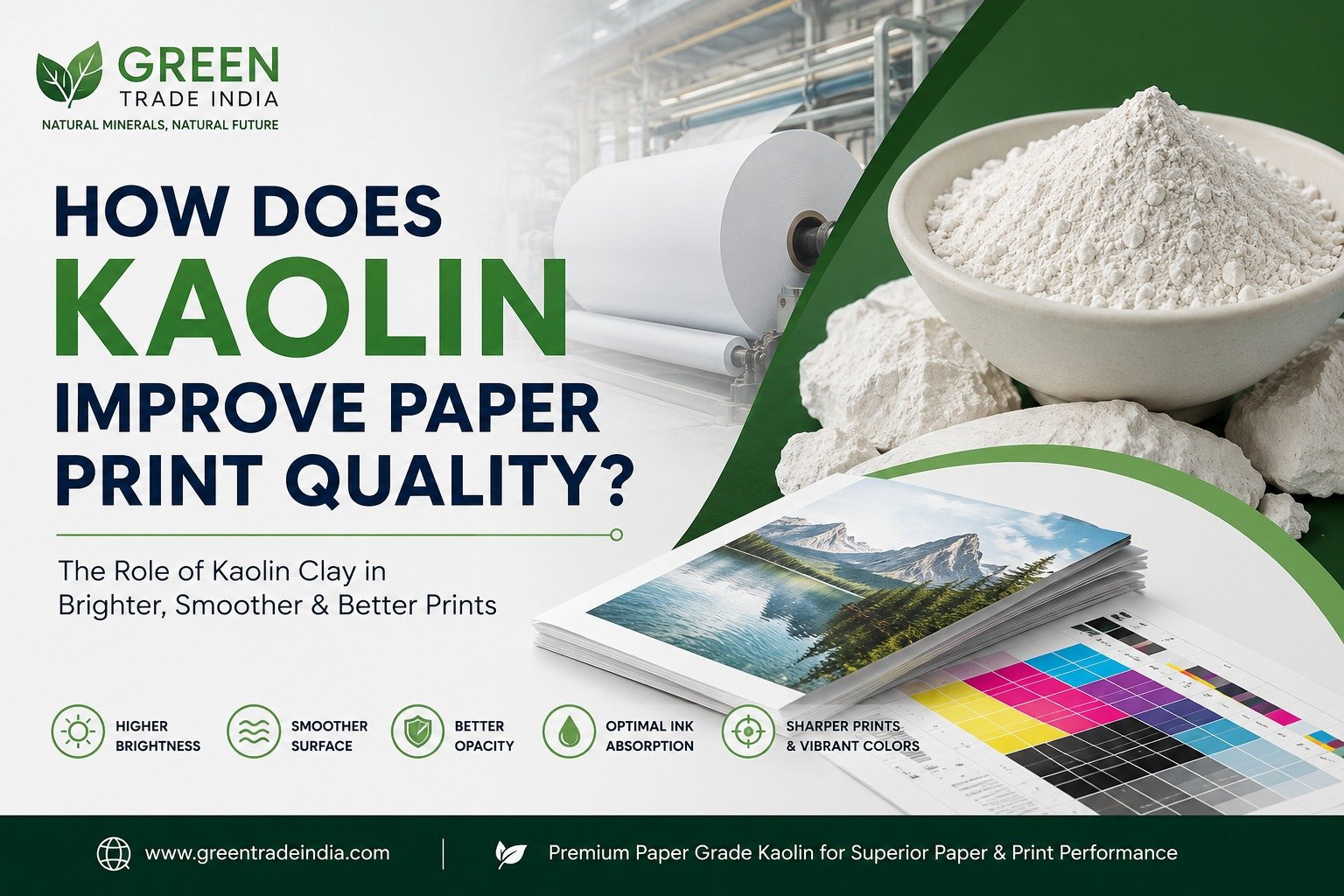
Kaolin for Paper
Kaolin is used in the paper industry as a coating and filler material.
Its fine particle size and brightness can contribute to:
- Surface smoothness
- Opacity
- Printability
- Brightness
- Coating performance
The required kaolin specifications vary according to paper type and manufacturing process.
Kaolin for Paints and Coatings
Kaolin can function as a mineral extender and functional filler in paints and coatings.
Depending on the grade, kaolin may influence:
- Opacity
- Brightness
- Rheology
- Surface finish
- Dispersion
- Coating performance
Kaolin for Plastics and Rubber
Kaolin can be incorporated into selected plastic and rubber formulations as a functional mineral filler.
Its performance depends on particle size, surface characteristics, treatment and compatibility with the polymer system.
Other Industrial Applications
Kaolin is also used in a range of other applications, including selected uses in:
- Adhesives
- Sealants
- Construction materials
- Printing applications
- Specialty fillers
- Industrial formulations
The appropriate grade should always be selected according to the specific technical requirements of the application.
What Specifications Should You Check When Buying Kaolin?
If you are purchasing kaolin for an industrial application, looking only at the product name is not enough.
Important specifications may include:
| Specification | Why It Matters |
|---|---|
| Mineral composition | Helps determine the material's characteristics |
| Kaolinite content | Indicates the principal mineral component |
| Brightness | Important for white and light-colored applications |
| Particle size | Influences dispersion and performance |
| Moisture | Important for storage, handling and formulation |
| Fe₂O₃ content | Can influence color and brightness |
| TiO₂ content | May affect color and optical properties |
| Oil absorption | Important for paints, coatings and fillers |
| pH | Can affect formulation compatibility |
| Surface treatment | Important for specialized applications |
| Processing method | Can influence consistency and performance |
Why Does Kaolin Composition Vary?
Natural kaolin is formed under different geological conditions, so deposits do not necessarily have identical mineralogical compositions.
Variations can result from:
- Geological origin
- Parent rock
- Weathering conditions
- Depositional environment
- Associated minerals
- Beneficiation methods
- Particle classification
- Refining processes
As a result, two kaolin products can have different technical properties even when they are both marketed simply as “kaolin.”
How to Choose the Right Kaolin Grade
The right kaolin grade depends on the intended application and the technical requirements of the manufacturing process.
Before selecting a material, consider:
- Application: Determine whether the kaolin will be used in ceramics, paper, coatings, plastics, rubber or another process.
- Mineral composition: Review the mineralogical composition and kaolinite content.
- Particle size: Select a particle-size distribution suitable for the intended formulation.
- Brightness: Check brightness requirements where color and opacity are important.
- Chemical specifications: Review parameters such as Fe₂O₃, TiO₂, moisture and pH.
- Processing: Consider whether the material is washed, refined, classified or surface-treated.
- Consistency: For manufacturing, consistent batch-to-batch specifications are important.
- Technical documentation: Review the product specification and certificate of analysis before making a purchase.
At Green Trade India, we understand that selecting an industrial mineral is not simply about choosing a product name. The right material should match the technical requirements of the manufacturing process.
Kaolin vs Kaolinite: Key Takeaway
The kaolinite vs kaolin distinction is straightforward once the two terms are viewed from a mineralogical and industrial perspective.
Kaolinite is a specific clay mineral with the chemical formula Al₂Si₂O₅(OH)₄. Kaolin is a naturally occurring clay or clay-rich material predominantly composed of kaolin-group minerals, particularly kaolinite, and may contain other minerals depending on its source and processing.
For industrial applications, the most important consideration is not simply whether a material is called kaolin. Manufacturers should evaluate its actual mineral composition, particle size, brightness, moisture, chemical properties and other relevant technical specifications.
Looking for the Right Kaolin Material?
Choosing kaolin for an industrial application requires more than comparing product names. Mineral composition, particle size, brightness, purity and other technical specifications can directly influence material performance.
If you are evaluating kaolin for ceramics, paper, paints, coatings, plastics or another industrial application, contact Green Trade India to discuss your requirements and identify a suitable material based on your application and specifications.
Choose kaolin based on its technical properties—not just its name.
Our Popular Categories
Kaolin Clay | Kaolin Powder | Kaolin Noodles | Kaolin Granules
Frequently Asked Questions About Kaolinite vs Kaolin
1. What is the difference between kaolinite and kaolin?
Kaolinite is a specific clay mineral, while kaolin generally refers to a natural clay or clay-rich material predominantly composed of kaolin-group minerals, especially kaolinite. Kaolin may also contain smaller amounts of other minerals depending on its geological source and processing.
2. Is kaolinite the same as kaolin?
No. Kaolinite is a mineral species, whereas kaolin generally describes a natural clay or clay-rich material predominantly containing kaolin-group minerals. Kaolinite is the principal mineral associated with many kaolin materials.
3. Is kaolin made from kaolinite?
Kaolin commonly contains kaolinite as its principal mineral component. However, natural kaolin can also contain other minerals, so its exact composition depends on the deposit and processing.
4. What is the chemical formula of kaolinite?
The chemical formula of kaolinite is Al₂Si₂O₅(OH)₄.
5. Does kaolin have a chemical formula?
Unlike kaolinite, natural kaolin does not necessarily have one fixed chemical formula because it is a natural material whose mineralogical composition can vary.
6. Which is purer: kaolinite or kaolin?
Pure kaolinite represents a specific mineral composition. The purity of commercial kaolin depends on its source, mineral composition and processing. Therefore, buyers should compare actual technical specifications rather than assuming that one term automatically indicates greater purity.
7. What minerals can be present in natural kaolin?
Natural kaolin can contain kaolin-group minerals along with varying amounts of other minerals such as quartz, mica or feldspar, depending on the geological deposit and processing.
8. What are the main uses of kaolin?
Kaolin is widely used in ceramics, paper, paints, coatings, plastics, rubber and other industrial applications. The required grade depends on the properties needed for each application.
9. What properties of kaolin are important for industrial applications?
Important properties can include brightness, particle-size distribution, mineral composition, moisture, pH, oil absorption, iron and titanium content, surface characteristics and processing history.
10. How do I choose the right kaolin grade?
Choose a kaolin grade according to the intended application and review its mineralogical composition, particle size, brightness, moisture, chemical specifications and other technical parameters. A product specification sheet or certificate of analysis can help determine whether a grade is suitable for your process.